Algorithmic Complexity
True or False: A function with a big-O notation of O(n) will always run faster than a function with a big-O notation of O(n2) for all inputs.
What type of input does Big-O notation consider?
Best Case
Worst Case
Average Case
True or False: Big-O notation provides a precise measurement of the actual runtime of an algorithm on a specific machine.
If an algorithm has a time complexity of O(1), it means its runtime is:
Linear
Constant
Quadratic
Exponential
If an algorithm has a time complexity of O(n), it means its runtime is:
Linear
Constant
Quadratic
Exponential
If an algorithm has a time complexity of O(n2), it means its runtime is:
Linear
Constant
Quadratic
Exponential
If an algorithm has a time complexity of O(2n), it means its runtime is:
Linear
Constant
Quadratic
Exponential
Consider the following function:
def foo(outer_input: list[str], inner_input: list[str]) -> None:
    """Nested loop!"""
    for x in outer_input:
        for y in inner_input:
            print(f"{x} and {y}!")
    return None
8.1. Assuming
outer_inputandinner_inputboth have length n, what is the big-O runtime of the functionfoo?8.2. If
outer_inputhas length n2 andinner_inputhas length n, what would be the big-O runtime of the functionfoo?Which of the following is true about algorithms?
The result of an algorithm is only affected by its inputs.
An algorithm can have side effects which affect its environment.
An algorithm can take an infinite number of steps to complete.
The only effect that an algorithm can have is on its result.
Consider the following code snippets:
unc_pid_range: dict[int, bool] = {730000000: False, 730000001: False, ..., 730999999: False}
prime_numbers: list[int] = [2, 3, 5, 7, ..., 1000000007]

for pid in unc_pid_range:
    if pid in prime_numbers:
        unc_pid_range[pid] = True
        print(f"Prime PID found: {pid}!")
unc_pid_range: list[int] = [730000000, 730000001, ..., 730999999] prime_numbers: dict[int, bool] = {2: False, 3: False, 5: False, 7: False, ..., 1000000007: False} for pid in unc_pid_range: if pid in prime_numbers: prime_numbers[pid] = True print(f"Prime PID found: {pid}!")Let n be the size of the
unc_pid_rangeand let m be the size of both theprime_numbersin both code snippets. What are the runtimes of the two code snippets in big-O notation in terms of m and n? Which would you choose to use if you cared the most about speed?
SOLUTIONS
This is False. A function with big-O notation of O(n) will theoretically run faster than a function with a big-O notation of O(n2) on a worst case input.
Worst Case.
False.
Constant
Linear
Quadratic
Exponential
8.1. O(n2)
8.2. O(n3)
The answer is b, since algorithms are a finite series of steps (eliminating c) and can be affected by and have an effect on their environment (eliminating a and d, and showing that b is true).
The first code snippet runs in time O(m ⋅ n) and the second runs in time O(n). This is because the lookup time (the
inoperator) takes constant time on a dictionary and linear time on a list, so in the first snippet you do an O(m) operation n times so $O(m n), but in the second you do an O(1) operation n times so O(n). Thus if you care about speed the most you would use the second method.
Unit Tests
Testing Syntax:
1.1. What key word do we use within a test function to ensure that a boolean expression is true?
1.2. What does each test function’s name have to begin with?
1.3. What does each test file’s name have to end with?
If a function passes all of its associated unit tests, then the function is implemented correctly for all possible inputs (True/False).
Consider the following code snippet:
def fill_list(num: int, length: int) -> list[int]:
    """Fill a list with a single value."""
    result: list[int] = []

    i: int = 0
    while i < length:
        result.append[num]
        i += 1

    return result

list_A: list[int] = fill_list(4, 19)
list_B: list[int] = fill_list(55, -2)
list_C: list[int] = fill_list(1, 110)
Which function calls would be considered a use case of this function (list the associated variable name e.g. list_A)? Which would be considered edge cases? If there are any edge cases, what result would you get in the associated variable(s)?
- Write three unit tests for the following function, two testing use cases and one testing an edge case.
def divide_list(input_list: list[int], divisor: int) -> list[float]:
    """Returns a new list where each value is the value from input_list divided by divisor"""
    result: list[int] = []

    for num in input_list:
        result.append(num / divisor)

    return result
SOLUTIONS
Question 1 Answers:
1.1.
assert1.2.
test_1.3.
_test.pyThis is False, as unit tests themselves can be incorrect so all tests passing is no guarantee of correctness even for the inputs the unit tests are testing for. Even if the unit tests are correct, there can still be certain inputs that they do not test for and therefore the unit tests cannot assure you that a function will always work properly. Unit tests are a helpful tool that can work well when implemented over a wide range of test inputs, but they must be accompanied by thoughtful implementation of the original function.
list_Aandlist_Cwould be use cases since this is how we would expect this function to be used andlist_Bwould be an edge case as this is essentially attempting to make a function call that would construct a list of negative length since ourlengthargument is -2. In this edge case the result would be an empty list since we would never enter thewhileloop.Note: These are just some examples of what you could test for, but they will likely not be the same as what you wrote as there are many correct answers.
The most straightforward use case test would be ensuring that on a normal input that the output is what you expect:
def test_normal_divide_list() -> None:
    classes: list[int] = [110, 210, 301, 455]
    assert divide_list(classes, 10) == [11.0, 21.0, 30.1, 45.5]
We could write another unit test to ensure that the original list was not mutated:
def test_no_mutate_divide_list() -> None:
    classes: list[int] = [110, 210, 301, 455]
    divide_list(classes, 10) # We don't need to store the result
    assert classes == [110, 210, 301, 455]
Finally, an example of an edge case for this function would be a divisor of zero, which we should expect to result in an error. We can test to ensure that an error occurs like this:
def test_div_zero_error_divide_list() -> None:
    classes: list[int] = [110, 210, 301, 455]
    with pytest.raises(ZeroDivisionError):
        divide_list(classes, 0)
Object-Oriented Programming
Multiple Choice
True or False: All instances of a class have the same attribute values.
True
False
True or False: An object’s attribute values cannot be accessed from outside the class.
True
False
What is the difference between a class and an object?
A class is a collection of objects
A class is a blueprint; an object is a specific instance of that blueprint
They are the same in Python
An object can contain classes, but not the other way around
True or False: Because class definitions have attributes, local variables are not allowed inside method definitions.
True
False
What does it mean to “instantiate” a class?
Define the class
Import a module
Create an object from a class
Define attributes
True or False: The constructor of a class is only called once in a program, no matter how many objects of that class are constructed.
True
False
The first parameter of any method is _____ and it is given a reference to the object the method was called on.
me
self
init
this
current
An instance of a class is stored in the:
stack
heap
output
True or False: Once attributes are initialized in the initializer/constructor, the values cannot be changed.
True
False
True or False: A class definition introduces a new data type, or type of object, in your program.
True
False
SOLUTIONS
False
False
A class is a blueprint; an object is a specific instance of that blueprint
False
Create an object from a class
False
self
heap
False
True
Select All That Apply
Consider the following code listing. Select all lines on which any of the concepts below are found. Select if the concept is not in the code listing.
1 class Point:
2     x: float
3     y: float
4
5     def __init__(self, x: float, y: float):
6         self.x = x
7         self.y = y
8
9     def flip(self) -> None:
10        temp: float = self.x
11        self.x = self.y
12        self.y = temp
13
14    def shift_y(self, dy: float) -> None:
15        self.y += dy
16
17    def diff(self) -> float:
18        return self.x - self.y
Constructor Declaration
1
2
5
9
11
Attribute Declaration
2
3
6
7
10
Attribute Initialization
2
3
6
7
10
Method Declaration
1
9
10
14
17
Local Variable Declaration
2
3
6
7
10
Instantiation
1
5
9
10
N/A
SOLUTIONS
Line 5 only
Lines 2 and 3
Lines 6 and 7
Lines 9, 14, and 17
Line 10
N/A
Short Answer
Use the following point class to answer the questions.
1 class Point:
2     x: float
3     y: float
4
5     def __init__(self, x: float, y: float):
6         self.x = x
7         self.y = y
8
9     def flip(self) -> None:
10        temp: float = self.x
11        self.x = self.y
12        self.y = temp
13
14    def shift_y(self, dy: float) -> None:
15        self.y += dy
16
17    def diff(self) -> float:
18        return self.x - self.y
Write a line of code to create an explicitly typed instance of the Point class called my_point with an x of 3.7 and y of 2.3.
Write a line of code to change the value of the my_point variable’s x attribute to 2.0.
Write a line of code to cause the my_point variable’s y attribute to increase by 1.0 using a method call.
Write a line of code to declare an explicitly typed variable named x. Initialize x to the result of calling the diff method on my_point.
SOLUTIONS
my_point: Point = Point(x=3.7, y=2.3)my_point.x = 2.0my_point.shift_y(1.0)x: float = my_point.diff()
Memory Diagrams
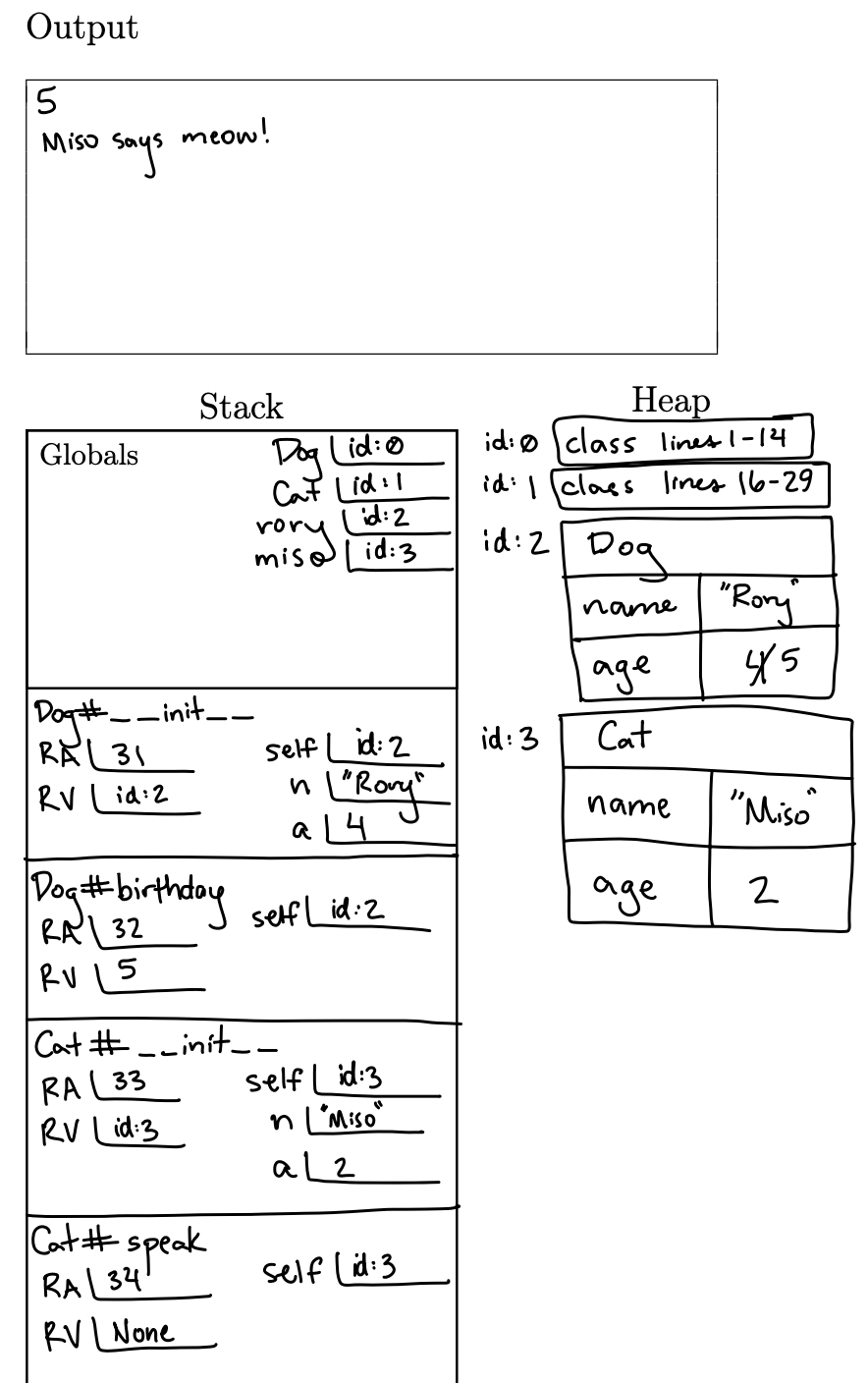
- Complete a memory diagram for the following code listing.
1 class Dog:
2     name: str
3     age: int
4
5     def __init__(self, n: str, a:int):
6         self.name = n
7         self.age = a
8
9     def speak(self) -> None:
10        print(self.name + " says woof!")
11
12    def birthday(self) -> int:
13        self.age += 1
14        return self.age
15
16 class Cat:
17    name: str
18    age: int
19
20    def __init__(self, n: str, a:int):
21        self.name = n
22        self.age = a
23
24    def speak(self) -> None:
25        print(self.name + " says meow!")
26
27    def birthday(self) -> int:
28        self.age += 1
29        return self.age
30
31 rory: Dog = Dog(n = "Rory", a = 4)
32 print(rory.birthday())
33 miso: Cat = Cat("Miso", 2)
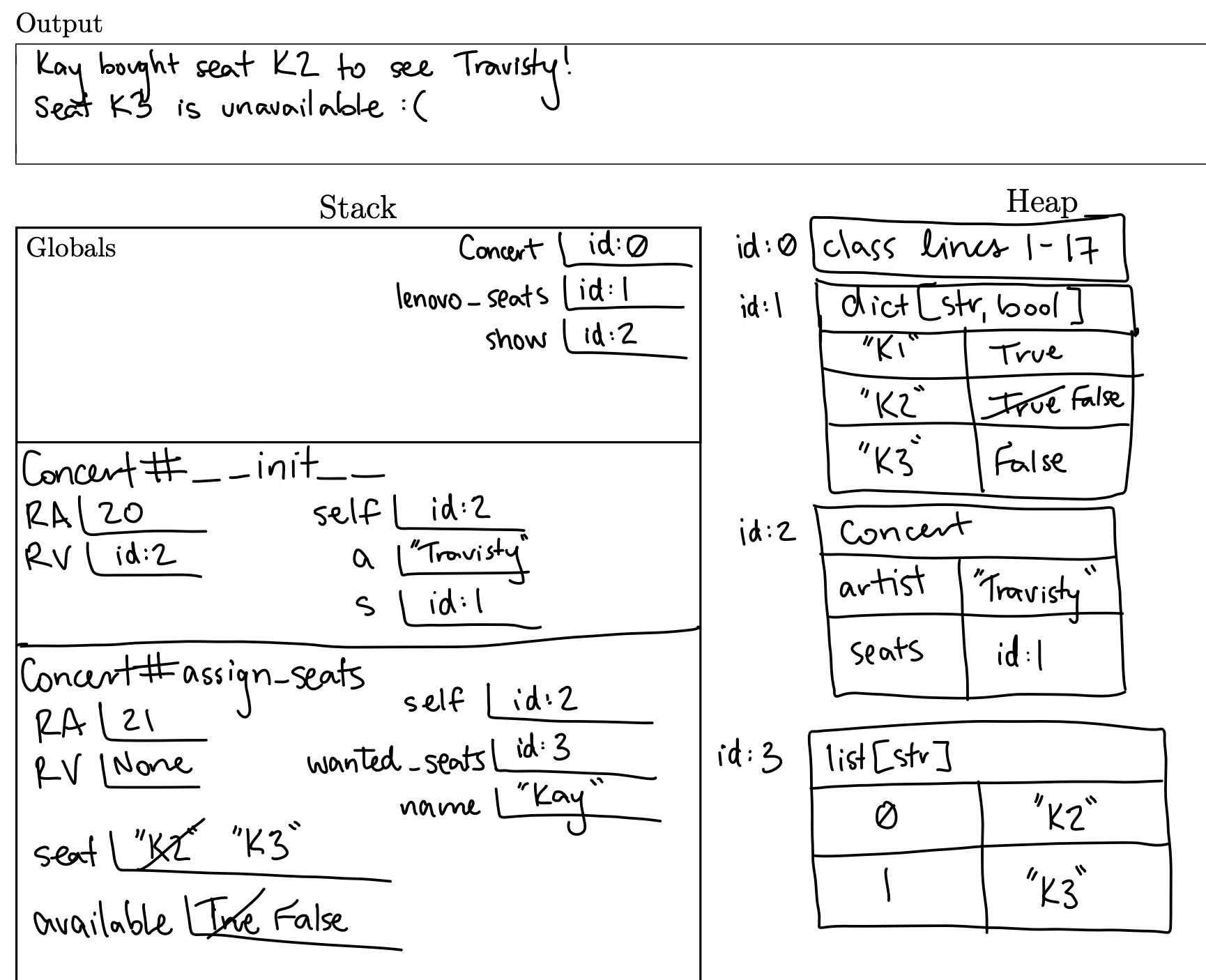
34 miso.speak()- Complete a memory diagram for the following code listing.
1  class Concert:
2      artist: str
3      seats: dict[str, bool]
4
5      def __init__(self, a: str, s: dict[str, bool]):
6          self.artist = a
7          self.seats = s
8
9      def assign_seats(self, wanted_seats: list[str], name: str) -> None:
10         for seat in wanted_seats:
11             if seat in self.seats:
12                 available: bool = self.seats[seat]
13                 if available:
14                     print(f"{name} bought seat {seat} to see {self.artist}!")
15                     self.seats[seat] = False
16                 else:
17                    print(f"Seat {seat} is unavailable :(")
18
19 lenovo_seats: dict[str, bool] = {"K1": True, "K2": True, "K3": False}
20 show: Concert = Concert(a = "Travisty", s = lenovo_seats)
21 show.assign_seats(wanted_seats = ["K2", "K3"], name = "Kay")